WR·02
How Time Makes Us · independent
Knowledge, History and Narrative in Our Relationship to Self and the World
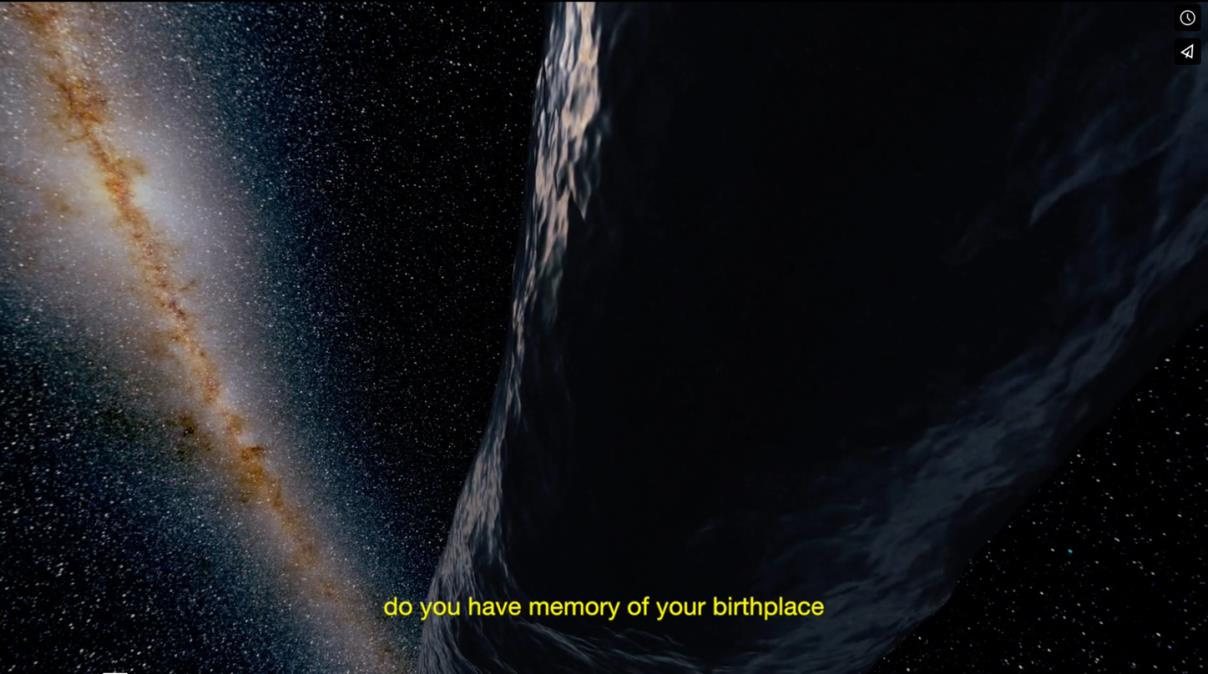
Imagine witnessing a nebula expand—a silent vastness. Picture an undulating pillar pulsing, midnight water intersecting with an orange-white spill of stars. Time slowly drags towards the meeting point. “My sister…” a familiar voice asks in Tagalog. “Do you have memory of your birthplace?” Orange reflects in the divots of the water. Rotating. A slow, cyclical hurricane sits at the centre of the space-cosmic-universe. Two pupils emerge, unfamiliar script rolling in their sapphire irises. “When the salt filled your eyes and your body fell into the floorless ocean.”
“Do you remember?” the voice asks.
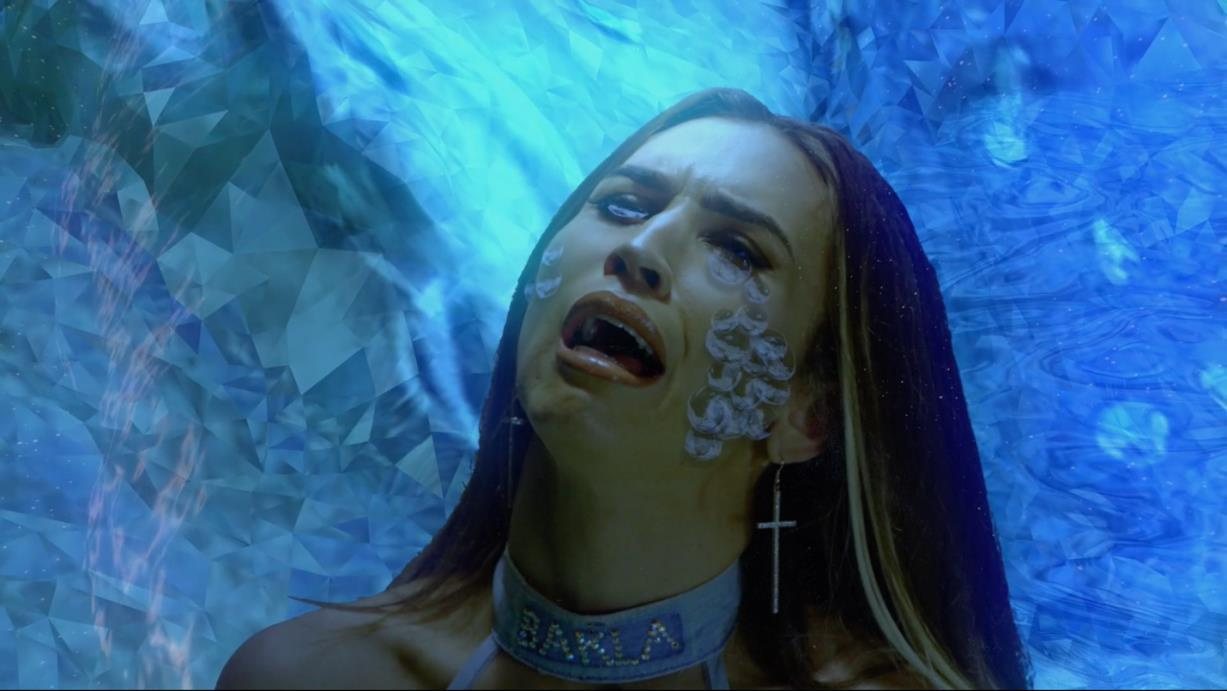
Imagine a techno-queer, gamified ocean floor. Long-haired and beautiful, she cries from her electric eyes. “BAKLA” is bedazzled on the denim choker around her neck. Her tears return to the deep time of the ocean.
These imaginings are from Ex Nilalang1 by Filipino-Queer artists Justin Shoulder and Bhenji Ra, known collectively as Club Até. The artwork dreams ‘future folklores’2 into existence, collapsing the histories of Filipino mythologies and queer ontologies. In these meetings of mythological creatures, re-envisioned in queer ways,
“We witness yearnings, complexities and utopias that resist forces of surveillance and demolition. It is no coincidence that the creatures we have been taught to hate are racialised and gendered. Yet these same creatures teach us how to reformulate kinship in ethical, non-violent ways.”3
Our exploration of queer temporality begins in the space of mythology and storytelling, recognising their inherent value as foundational resources for comprehending the nuances of non-linear time. We will then explore some First Nation’s understandings of non-linear time. Finally, we will delve into theories by dominant scholars in the canon of Queer temporality. The discussion will extend to Edelman, his critiques and Muñoz’s theory of queer utopic futurity.
Mythology is inherently entwined with time, moving through history in cyclical patterns, conveying universal human experiences through culturally specific lenses. Often transmitted through oral traditions, myths collapse the distinctions between past, present, and future.4 Each retelling of a myth exists in its own temporal context while coexisting with other retellings, challenging Western linear temporalities. Starting where you are: First Nations non-linear storytelling5 is a valuable resource that explains the non-linear nature of First Nations storytelling ontologies. Author Sara Kianga Judge explains,
“non-linear thinking can create beautiful webs of all different kinds of connected patterns that reflect the connected patterns found in our lives and ecosystems.”
Recognising this distinction is essential, as colonial systems have broadly weaponised time to maintain ‘control over’ by asserting that Western concepts of time are ‘real-time’ – a system theorist Elizabeth Freeman calls chrononormativity6. She explains that “chrononormativity is a mode of implantation, a technique by which institutional forces come to seem like somatic facts… forms of temporal experience that seem natural to those whom they privilege.”7 The cyclical nature of myths challenges colonial attempts to assert chrononormativity, embracing a non-linear continuum. In this context, Club Até’s work stands as a utopic performance of queer hope within the history of the now-future. Benji Ra explains, “Looking further back, to indigeneity and pre-colonisation as part of the present – and the future as well. It’s not just this new imagined world. It’s the past as an alive thing that keeps on being performed into the future.”8
Dr. Tyson Yunkaporta, an author, educator, and maker from the Apalech Clan in far north Queensland, provides a concise and accessible explanation that helps differentiate First People’s understandings of time from colonial chronologies. He says,
“‘First Peoples’ law says that nothing is created or destroyed because of the infinite and regenerative connections between systems. Therefore time is non-linear and regenerates creation in endless cycles. Second People’s law says that systems must be isolated and exist in a vacuum of individual creation, beginning in complexity but simplifying and breaking down until they meet their end. Therefore time is linear, because all things must have a beginning, middle and end.”9
Navigating non-linear temporalities proves challenging for someone raised in a predominantly white-western context. Yet, recalling moments from my childhood on the farm offers insights. Learning from my dad – not to disturb the complex ecosystem under sticks, being shown how to carefully untangle the roots of tree saplings before planting them in a tree line so that the birds have a safe path through the industrially tilled, monoculture paddocks – reveals lessons in non-linear temporality. While not explicitly based in a queer or Indigenous ontology, these care practices disrupt Western-capitalist notions of time. These moments of care become performances of a utopic future in the present, which speak back to histories of violence and extraction while investing in futures he never expects to see. These learning processes reveal a ‘transtemporal consciousness of time’, which parallels the Indigiqueer utopia in the poetry collection Full-Metal Indigiqueer by Joshua Whitehead10. In this collection, Whitehead helps illuminate the intersections between Indigenous and Queer temporalities. Whitehead's work disrupts the linear trajectory of colonial time by introducing Zoa, a two-spirit/Indigiqueer character. Zoa’s cyber-space, fourth dimension world-building, explores colonial traumas that permeate the present while constructing an Indigiqueer utopic futurity within a digital Indigenous temporality.11
Beginning our exploration of queer time in this way is essential, as it prompts us to acknowledge that non-linear temporalities are not a recent theoretical innovation. A Queer temporal theory does not find its inception solely in the moment of its formalisation within the academic domain in the 90s.12 This is not merely because framing it as such would contradict its inherent theoretical views on time. Also, because it is intricately linked to feminist, post-colonial, and critical race theory, alongside numerous Indigenous philosophies.13 To explore how queer theorists have advanced understandings of temporality, I will direct my focus to the dominant canon. However, even in the dominant canon, a stable understanding of queer time is unattainable. In the spirit of Sedgwick’s first axiom for queer theory, “People are different from each other.”14 There are as many definitions and understandings of queer time as there are those who experience or conceptualise it. This diversity is exemplified in a roundtable discussion involving numerous prominent theorists, making it an ideal starting point for elucidating the nuanced meanings associated with queer time. In this roundtable, led by Freeman, the scholars aim to scrutinise the potential political and social implications of incorporating time into queer theory. Freeman poses a pivotal question, inquiring whether queer temporal theory, for the scholars involved, serves as a catalyst for transformative change or imposes limitations.15
Carolyn Dinshaw responds by articulating that her exploration of temporality stems from a discomfort with entrenched Western academic traditions that cast the 'past as other.'16 Motivated by a profound belief in the untapped potential of the past in shaping the present, Dinshaw advocates for an alternative historical framework, proposing touch as a method capable of intricately intertwining or 'collapsing' time. Dinshaw contends that engaging in 'historical touching across time'17 can facilitate the formation of communities that span temporal barriers, incorporating marginalised voices from the past and present, including queer adjacent identities. Dinshaw justifies this approach by noting the ‘queer desire’ for affirming and hopeful history. In this context, history is something that relates and transfers across time, not a causal, linear narrative.18 While Dinshaw acknowledges that historical weaponisation of this perspective has led to significant harm, she notes that this shows the strong potential of theorising temporality for social and political impact.
Jagose steers her inquiry towards a more nuanced exploration of the interconnections between race, class, and the obscured histories of sexuality, aiming to dismantle entrenched historical hegemonies upholding Western systems of oppression. Her trajectory into the realm of temporality unfolds through a meticulous analysis of social tropes, such as the lesbian, “the unwed mother, the priapic black heterosexual male, and the working-class homosexual.”19 These identities, she contends, disrupt conventional temporal structures enforced by the traditional family model perpetuated by the capitalist nation-state. Importantly, Jagose reminds us that not all non-linear temporalities can or should be framed as queer, saying,
“What difference might it make to acknowledge the intellectual traditions in which time has also been influentially thought and experienced as cyclical, interrupted, multilayered, reversible, stalled — and not always in contexts easily recuperated as queer?”20
Halberstam moves the conversation away from strongly academic theorisations and identifies moments in queer experience which engage with temporality. There is the moment of seemingly pointless bad drag and the moment in school where Halberstam is told he is being prepared for marriage and family life.21 It is this explanation which reveals a more precise understanding to me of what is meant by non-linear queer temporal experiences. To Halberstam, queer time is non-linear, asynchronous, and outside traditional markers. Queer chronologies critique normative concepts of time, embracing alternative temporalities and subversive behaviours. Halberstam explains,
“I hear a loud voice in my head saying fuck family, fuck marriage, fuck the male teachers, this is not my life, that will not be my timeline. Queer time for me is the dark nightclub, the perverse turn away from the narrative coherence of adolescence – early adulthood – marriage – reproduction – child rearing – retirement – death, the embrace of late childhood in place of early adulthood or immaturity in place of responsibility.”22
This moment in Halberstam’s response identifies the linear heteronormative temporalities enforced in dominant culture. He identifies how Queer experiences tend to refuse this linear progression, forming kinships and relational structures which do not rely on the biological family. As Nguyen Tan Hoang argues, “queer experience gets transmitted from one generation to the next, a process that exceeds, in innovative ways, the heterosexual kinship/ reproductive model.”23 In this sense, queerness as a culture is passed upwards, backwards, and together, collapsing strict distinctions between the past and the future.
Amidst all of the ironically complex and cyclical discussions about queer temporality, Lee Edelman’s theories challenged me the most. Edelman's work centres on "reproductive futurism,"24 advocating for a queer refusal of the heteronormative emphasis on The Child as a symbol of the future.25 His response to the roundtable is an intense and complex web of analysis which refuses to be confined to a “turn towards time”. Edelman contends that queerness challenges the subject's identification with a death drive, disrupting the idea of being subjects of history confined by futurism's illusion of productivity. The death drive, in Freudian terms, represents an instinctual force within individuals that pushes towards self-destruction, repetition, and the undoing of established structures.26 Edelman applies this concept to queer theory, suggesting that queerness disrupts conventional narratives of reproduction, futurism, and historical continuity.27
Considering my theorisations of queerness align much more closely to the logics of José Esteban Muñoz, I struggled to reconcile with Edelman’s staunch disavowal of all forms of futurity. While I appreciate the importance of recognising the impact of reproductive futurism as enforced by the capitalist/colonial state, Muñoz argues that the nature of queerness as the refusal of hetero-colonial-capitalist systems cultivates a desire for a better future and that the act of imagining this future allows it to exist in the present. Muñoz posits that it is precisely this queer desire which summons hopeful futures into the present.28 I grappled for a while, trying to reconcile with Edelman’s nihilism and his apparent rejection of community, the collective, and any responsibility to others. Eventually, I discovered a whole genre of responses to his work, firmly rejecting his theory.
In response to Edelman, Sieranski imagines the futurity of the ‘Child of Colour’, recognising that Edelman’s theorised ‘Child’ of reproductive futurism relied on a strategic whiteness. Sieranski contends that, in this context, The Child must be white if it is to advance the futurity of the colonial state’s desires. In Contrast, the Child of Colour is a destabilising influence and does not ‘perpetuate sameness’.29 Sieranski urges Queer theory to “acknowledge that the experience of the cis white gay man, the trans black lesbian, and the genderfluid Asian pansexual are not totally the same experience.”30 A pointed nod to Edelman’s attempts to make broad theorisations from a positionality which only considers his own relatively privileged white, middle-class viewpoint. Citing Diana Fuss, Angela Jones aligns with this view, pointing out that Edelman’s willingness to accept rejection may be because he is “already, to some degree, comfortably entrenched on the inside.”31 As Jones recognises, Edelman’s problem with queer futurity stems from a rejection of compassion and empathy and a rejection of collective power and solidarity across intersection points of marginalisation. In Cruising the Toilet, Muñoz emphasises the power of queer collective futurities, challenging Edelman’s radical negativity and charging him with attempting to separate race from queerness in order to avoid tainting the ‘purities of sexuality as a singular trope of difference”.32 Muñoz says,
“It is important not to hand over futurity to normative white reproductive futurity… more reason to call on a utopian political imagination that will enable us to glimpse another time and place: a “not-yet” where queer youths of color actually get to grow up. Utopian and wilfully idealistic practices of thought are in order if we are to resist the perils of heteronormative pragmatism and Anglo-normative pessimism.”33
Muñoz goes on to point out that the jouissance34 of nihilism and rejection of the future advocated for by Edelman is not something afforded to all queer subjects. In other words, abstracting identities of race, gender and class from queerness is “a ticket whose price most cannot afford.”35 Clarifying this point, Schotten notes that ‘it seems particularly cruel and benighted to dismiss futurist movements and political struggles when they are so often waged precisely by those who were never meant to survive.’36 Ultimately, despite an attempt to understand Edelman, it is Muñoz’s belief in the potentiality of queer-worldmaking37 which holds my focus. Unlike Edelman, I cannot reconcile with a theory that fails to consider what we owe to one another and ignores those we might leave behind in our individualistic nihilism.
In searching for alternative theories of futurity, I was struck by the sensitive and self-reflective analysis of Jane Ward in “Locating Parenthood in Queer Utopia.”38 Ward presents a framework for queer parenthood outside of reproductive futurism. Ward reminds us that queer, Indigenous, and parents of colour often engage in parenthood in a context where parenting has been actively withheld rather than an expectation. To apply Edelman’s theory of homonormative reproductive futurism in these contexts would drastically fail to recognise the potential of radical queer utopic futurity evident in these parenting acts.
Considering my personal history in the context of time brings to mind the honey-coloured wooden interior of our old house. Lacquered by family for generations, my dad was determined to preserve its unique quality. These walls bear witness to a nuanced understanding of time. It is an archive of stories of loss and hope embedded in the layers of lacquer, raising questions about whose histories are remembered, valued, and forgotten. These re-interpretations of memory unfold a non-linear temporality, weaving tales of stolen places, extractive destruction, and erased identities, intertwining the histories of settler hope and Wiradjuri loss in my family home. Growing up on land scarred by colonial-capitalist legacies demands a deliberate unlearning and relearning of temporalities. This process is urgent as it unveils ongoing cycles of harm in the present, compelling us to disrupt them. When discussing utopic futurities, Muñoz calls this unnecessary repetition of history the “tautological nature of the present.”39
Queer temporalities echo this complexity, entangled in erased histories and debates about the retrospective acknowledgment of queerness. The intersection of Queer and Indigenous identity, however, brings an even more complex relationship to temporality and history. Returning to Whitehead’s poem “mihkokwaniy”40 allows us to navigate this complexity. Whitehead reveals how colonial linearity, which often relegates anything older than a few hundred years to the distant past, freezes the character in ‘colonial historiography’ - as theorised by Spivak41. However, the character is simultaneously denied a past due to the colonial erasure of queer histories, thereby resulting in a ‘cyclical time loop,’42 which complicates anachronistic norms. Muñoz argues that in order to break this time loop, queer utopic futurities must know the present “in relation to the alternative temporal and spatial maps provided by a perception of past and future affective worlds.”43 In other words, deconstructing linear narratives, specifically while dreaming queer and post-colonial futures, does not imply disregarding the past, especially oppressive cycles. Instead, it necessitates a confrontation with these atrocities, for failure to do so ensures a future haunted by violence.
Muñoz’s writing is like hopeful poetry explaining the non-linear interactions of time within hopeful queer futurities. He says,
“I see world-making here as functioning and coming into play through the performance of queer utopian memory, that is, a utopia that understands its time as reaching beyond some nostalgic past that perhaps never was or some future whose arrival is continuously belated—a utopia in the present.”
In traversing the landscapes of queer temporality, we unravel a rich tapestry woven with diverse perspectives, challenging linear narratives and offering glimpses into alternative futures. From the embracing folds of mythology to the critical analyses of scholars like Edelman and Muñoz, the discourse on queer time is a nuanced, intersectional dialogue. Queer theorists embark on this journey not just as an intellectual pursuit but, more fundamentally, as a response to an ontological gut feeling—an inherent sense that Western linear temporalities inadequately capture the essence of queer experiences. Moreover, this engagement with temporality is deeply entwined with a commitment to harness the potent political and social force of destabilising linear time. Time, often wielded as a form of control by Western-capitalist-colonial systems, becomes a battleground for resistance and transformation. By acknowledging the complexities of non-linear temporalities and the transformative potential of queer utopic futurity, we navigate not only the cyclical nature of history but also the pressing responsibility to confront and disrupt oppressive cycles. In this ongoing dance between past, present, and future, queer temporality emerges as a dynamic force, shaping narratives, challenging norms, and fostering a utopia rooted in the transformative power of collective hope.
Footnotes
1. Club Até. “Club Ate : Ex Nilalang.” Phasmahammer, 2017. phasmahammer.com/exnilalang.
2. Lim, Eugenia, “Bhenji Ra on Embodying Future Forms.” Assemble Papers, 2022.
3. Club Até, op. cit.
4. Conrad, JoAnn. “The Storied Time of Folklore.” Western Folklore 73, no. 2/3. 2014, p. 323–52.
5. Sara Kianga Judge, “Starting Where You Are: First Nations Non-Linear Storytelling,” The Australian Museum, 2022.
6. Freeman, Elizabeth. Time Binds: Queer Temporalities, Queer Histories. Durham: Duke University Press, 2010, p. 3.
7. ibid.
8. Lim, op. cit.
9. Yunkaporta, Tyson. “A Rainbow Serpent Theory of Time.” Garland Magazine, 2019.
10. Uy, Royce. “A Digital Queer Utopia: Full-Metal Indigiqueer.” The Garden Statuary, 2023.
11. Whitehead, Joshua. Full-metal indigiqueer: Poems. Vancouver, British Columbia: Talonbooks, 2017.
12. Freeman, op. cit.
13. McBean, Sam. Feminism’s Queer Temporalities. London: Taylor & Francis Group. 2015. p. 11.
14. Sedgwick, Eve Kosofsky. Epistemology of the Closet. University of California Press, 2008, p. 22.
15. Freeman in Roundtable. Dinshaw, Carolyn, Lee Edelman, Roderick A. Ferguson, Carla Freccero, Elizabeth Freeman, Judith Halberstam, Annamarie Jagose, Christopher Nealon, Nguyen Tan Hoang; Theorizing Queer Temporalities: A Roundtable Discussion. GLQ 13 (2-3), 2007. p. 177. doi.org/10.1215/10642684-2006-030.
16. Dinshaw in Roundtable, op. cit., p. 178.
17. ibid.
18. Dinshaw in Roundtable, op. cit., p. 185.
19. Jagose in Roundtable, op. cit., p. 180.
20. Jagose in Roundtable, op. cit., p. 187.
21. Halberstam in Roundtable, op. cit., p. 181–182.
22. ibid.
23. Tan Hoang in Roundtable, op. cit., p. 183.
24. Edelman, Lee. No Future: Queer Theory and the Death Drive. Durham: Duke University Press. 2004.
25. ibid.
26. Edelman, op. cit., p. 9.
27. Edelman in Roundtable, op. cit., p. 181. And Edelman, op. cit., p. 17.
28. McBean, op. cit. p. 11.
29. Sieranski, Kristen. “What Future?: Imagining The Child of Color in Response to Lee Edelman’s No Future.” Concept. Interdisciplinary Journal of Graduate Studies 42. 2019, pp. 4, 7, 9.
30. ibid. p. 15.
31. Jones, Angela. A Critical Inquiry into Queer Utopias. New York: Palgrave Macmillan US, 2013. pp. 10–11.
32. Muñoz, José Esteban. Cruising Utopia: the Then and There of Queer Futurity. New York: NYU Press. 2009, p. 11.
33. Muñoz, op. cit., p. 365.
34. Edelman, op. cit.
35. Muñoz, op. cit., p. 365.
36. Schotten, C. Heike. Queer terror: Life, death, and desire in the settler colony. New York: Columbia University Press, 2018, p. 112.
37. Jones, op. cit., p. 11.
38. Jones, op. cit., pp. 233–243.
39. Muñoz, op. cit., p. 28.
40. Uy, op. cit.
41. Morris, Rosalind C., and Gayatri Chakravorty Spivak. Can the Subaltern Speak?: Reflections on the History of an Idea. New York: Columbia University Press. 2010, pp. 21–78.
42. Uy, op. cit.
43. Muñoz, op. cit., p. 27.
References
Club Até. “Club Ate: Ex Nilalang.” Phasmahammer, 2017. phasmahammer.com/exnilalang.
Conrad, JoAnn. “The Storied Time of Folklore.” Western Folklore 73, no. 2/3, 2014, pp. 323–52.
Dinshaw, Carolyn, Lee Edelman, Roderick A. Ferguson, Carla Freccero, Elizabeth Freeman, Judith Halberstam, Annamarie Jagose, Christopher Nealon, Nguyen Tan Hoang. Theorizing Queer Temporalities: A Roundtable Discussion. GLQ 13 (2–3), 2007.
Edelman, Lee. No Future: Queer Theory and the Death Drive. Durham: Duke University Press, 2004.
Freeman, Elizabeth. Time Binds: Queer Temporalities, Queer Histories. Durham: Duke University Press, 2010.
Jones, Angela. A Critical Inquiry into Queer Utopias. New York: Palgrave Macmillan US, 2013.
Judge, Sara Kianga. “Starting Where You Are: First Nations Non-Linear Storytelling.” The Australian Museum, 2022.
Lim, Eugenia, and Samuel Holleran. “Bhenji Ra on Embodying Future Forms.” Assemble Papers, 2022.
McBean, Sam. Feminism’s Queer Temporalities. London: Taylor & Francis Group, 2015.
Morris, Rosalind C., and Gayatri Chakravorty Spivak. Can the Subaltern Speak?: Reflections on the History of an Idea. New York: Columbia University Press, 2010.
Muñoz, José Esteban. Cruising Utopia: The Then and There of Queer Futurity. New York: NYU Press, 2009.
Schotten, C. Heike. Queer Terror: Life, Death, and Desire in the Settler Colony. New York: Columbia University Press, 2018.
Sedgwick, Eve Kosofsky. Epistemology of the Closet. University of California Press, 2008.
Sieranski, Kristen. “What Future?: Imagining The Child of Color in Response to Lee Edelman’s No Future.” Concept: Interdisciplinary Journal of Graduate Studies 42, 2019.
Uy, Royce. “A Digital Queer Utopia: Full-Metal Indigiqueer.” The Garden Statuary, 2023.
Whitehead, Joshua. Full-Metal Indigiqueer: Poems. Vancouver: Talonbooks, 2017.
Yunkaporta, Tyson. “A Rainbow Serpent Theory of Time.” Garland Magazine, 2019.
Why and how have queer theorists advanced new understandings of temporality.